
Garage Door Damage Guide
What to Do If You Back Into Your Garage Door
A practical guide to visible damage, safe operation decisions, documentation, repair, and replacement considerations.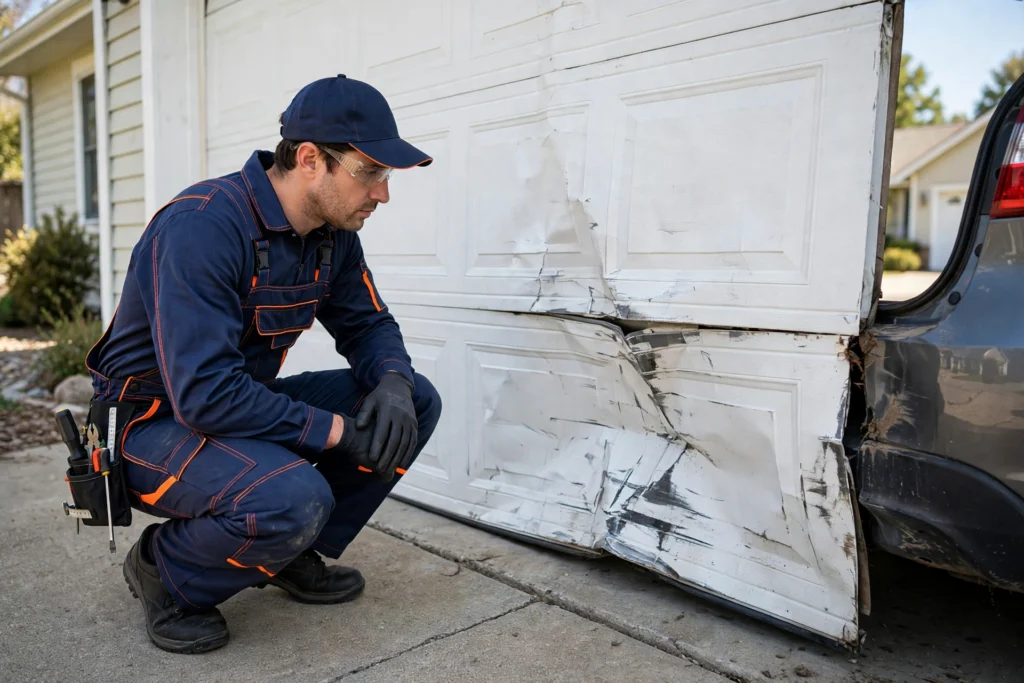
If you have backed into your garage door, avoid repeatedly operating it until you have looked for obvious displacement, track damage, damaged sections, broken glass, or anything interfering with normal movement. A dent may primarily affect appearance, but a vehicle impact can also affect alignment and operation elsewhere in the system.
The immediate goal is not to diagnose every component yourself. Pause, observe from a safe position, keep clear of damaged or tensioned parts, and decide whether the door appears stable enough to leave stationary while you determine the appropriate next step.
First, Stop and Look Before Operating the Door
It is tempting to press the remote, wall control, or keypad several times to see whether the door still works. Observation should come first. Sections travel through rollers in tracks, hinges connect moving sections, and springs and lifting cables help manage the door’s weight. From a safe position, look for displacement, a bent or separated track, a roller in an unusual position, broken glazing, debris, or other obvious interference. Do not put hands near gaps, hinges, cables, springs, brackets, or an unstable section.
Is It Safe to Open the Garage Door After Hitting It?
That depends on the complete door and operating system. Do not keep cycling a door that is visibly displaced or off track; has a bent or separated track; shows an apparent cable, spring, roller, or hardware problem; is badly distorted near an operating interface; contains broken glass or debris; or moves unevenly, binds, becomes unstable, or cannot travel normally.
A normal-looking dent does not prove that continued operation is safe, and an impact does not automatically make every door unsafe. When safe operation is uncertain, leaving the door stationary and arranging an inspection is more cautious than repeatedly testing it.
What Damage Should You Look For?
Begin at the impact area, then visually follow the sections and operating path. The purpose is to identify obvious changes—not to dismantle or correct components.
Door Sections and Panels
Look for dents, sharp creases, cracks or splits where the material permits them, finish damage, separation, deformation near edges or joints, and a section that no longer sits evenly against its neighbors.
Tracks
Observe both vertical tracks without trying to straighten or reposition them. Obvious bending, separation from mounting points, changed alignment, or a roller visibly displaced from the track can indicate more than surface damage.
Hinges and Rollers
Note hinges that appear twisted, pulled away, or differently positioned from matching hardware. A roller at an unusual angle or no longer following its track correctly may affect section travel.
Springs and Lifting Cables
These are tensioned components. Observe only from a safe distance for an obvious break, slack cable, displacement, or unusual position. Do not touch, adjust, reconnect, wind, unwind, move, or repair them.
Bottom Section and Weather Seal
Impacts commonly occur low on the door. Look for bowing or creasing and whether the lower edge and weather seal still make even contact with the floor.
Windows and Glass
Look for cracked or broken glazing and debris. Keep people and pets away, and do not reach through a damaged opening or move an unstable section to collect glass.
Cosmetic Dent or Operational Damage?
Cosmetic damage primarily changes appearance. Operational damage affects how the door aligns, supports itself, seals, or moves. Location matters: a center-surface dent may differ from a crease at a section edge, hinge, roller, joint, or track interface. Appearance alone proves neither that a dent is harmless nor that the door is structurally compromised; material, construction, location, severity, and complete-system findings determine the distinction.
What If Your Car Is Trapped Inside the Garage?
Moving the vehicle through another safe exit without operating or contacting the damaged door is different from forcing that door open. If it blocks the only vehicle exit, do not force it upward, pull cables, adjust springs, remove rollers, disconnect structural hardware, or push sections into alignment. When the door appears damaged, unstable, displaced, or unable to move normally, professional assistance may be the safer route.
Why Repeatedly Operating a Damaged Door Can Make Things Worse
If impact caused binding, misalignment, deformation, or track interference, continued cycling may place additional stress on connected parts. This does not mean every extra cycle causes damage; it means repeatedly opening the door to see whether it fixes itself is not a reliable diagnostic method and may move an unstable component into a worse position.
Can a Dented Garage-Door Panel Be Repaired?
Sometimes. Material, construction, dent or crease severity, impact location, finish, and operational effects matter. A shallow appearance issue differs from a sharp crease or damage near an attachment point. Avoid aggressive do-it-yourself dent removal when insulation, reinforcement, hardware, or finish condition is uncertain.
Can Just One Garage-Door Section Be Replaced?
One section may be replaceable when a compatible part is available and the surrounding door remains suitable. Manufacturer and model, design, age, finish matching, adjacent-section condition, hardware compatibility, and the wider impact all matter. Matching is not guaranteed, every model does not remain available, and section replacement does not automatically correct track, hinge, roller, alignment, or lifting-system damage.
When Might the Whole Garage Door Need Replacement?
Complete replacement may be considered when multiple sections are substantially deformed, damage extends beyond one section, tracks or other systems have broader issues, compatible sections are unavailable, or an older door already has significant wear. Applicable wind or performance requirements may also matter. No percentage formula determines the answer, and vehicle impact does not automatically require whole-door replacement.
Could the Impact Have Affected the Tracks or Other Hardware?
Yes. Force can transfer through sections, hinges, rollers, tracks, and attachments, changing alignment or component position beyond the visible dent. A complete evaluation may need to consider all of these areas. Springs and cables remain no-touch components for the homeowner.
What About the Garage-Door Opener?
The opener moves the door; it does not correct mechanical binding or displacement. If a damaged door is difficult to move, repeatedly commanding the opener is not an appropriate test. Straining, stopping, or reversing can reflect resistance elsewhere and does not by itself prove opener damage.
What Should You Photograph or Document?
Where safe, record the overall door, impact location, individual damaged sections, visible track or hardware condition without touching, vehicle damage, broken glass or debris, date, time, and circumstances. Documentation may help later discussions with a repair provider or insurer. Coverage depends on policy terms, cause, circumstances, deductible, and exclusions; photographs do not establish coverage or determine whether to file a claim.
What You Can Safely Do Yourself—and What You Shouldn’t
What Happens During a Professional Inspection?
The purpose is to determine whether the impact is limited to appearance or affects structure and operation. Depending on the situation, evaluation may include section condition, alignment, tracks, rollers, hinges, the lifting system, balance, opener interaction, safe operation, and replacement-section compatibility. The exact process varies by door and damage.
Repair One Section, Replace Sections, or Replace the Door?
These are decision prompts, not remote diagnoses. The appropriate option depends on inspection of the affected system.
| Situation | What may need to be considered |
|---|---|
| Minor isolated surface damage | Material, finish, dent shape, location, and any change in alignment or movement. |
| One significantly damaged section | Repairability, compatible section availability, adjacent sections, and hardware interfaces. |
| Multiple damaged sections | Combined deformation, system alignment, compatibility, and practicality of section work. |
| Section damage plus hardware concern | The complete operating system may need evaluation before a section-only decision. |
| Replacement section unavailable | Manufacturer availability, alternatives, door age, and possible complete replacement. |
| Older door with existing wear | The impact together with pre-existing section, hardware, finish, and operating condition. |
| Severe displacement or system damage | Safe stabilization, the full damage pattern, and options identified through inspection. |
What Should You Do Next?
- Stop repeated operation.
- Observe from a safe position.
- Keep clear of unstable and tensioned components.
- Document what happened.
- Consider whether alignment, hardware, sealing, or movement appears affected.
- Arrange inspection when damage exceeds a minor surface issue or safe operation is uncertain.
Frequently Asked Questions
Can I open my garage door after backing into it?
It depends on the whole system. Do not cycle a displaced, off-track, distorted, binding, unstable, or visibly damaged system. If safe operation is uncertain, leave it stationary and arrange inspection.
Can a dented garage-door panel be repaired?
Some dents may be repairable; sharp creases, formed-section damage, finish issues, or damage near joints and hardware may need another approach. Material, location, severity, and operation matter.
Can just one garage-door panel be replaced?
Possibly, when a compatible section is available and adjacent sections and hardware remain suitable. Model, age, design, matching, and wider damage affect the decision.
What if my car is stuck inside the garage?
Do not force the door or work on springs, cables, rollers, tracks, or structural attachments. If no other safe exit exists and the door appears damaged or unstable, professional assistance may be safer.
Can hitting the garage door knock it off track?
An impact can affect roller and track alignment, though not every impact does. A displaced roller, bent track, uneven movement, or displaced door are reasons to stop operation.
Could backing into the door damage the opener?
Possibly, but opener difficulty may reflect mechanical resistance in the door. The door system should be evaluated before assuming the opener is the primary fault.
Does insurance cover damage from backing into a garage door?
Coverage depends on the policy, cause, circumstances, deductible, exclusions, and insurer terms. Check the relevant policy or insurer for situation-specific guidance.
Primary Sources and Further Reading
- Clopay — Garage Door Safety Checklist
- Clopay — Residential Garage Door Service and Support
- Insurance Information Institute — How to File a Homeowners Claim
Backed Into Your Garage Door?
If the impact has left the door dented, displaced, or operating differently, Doorvo can inspect the damage and explain the appropriate repair or replacement options.